
Orland Park Previous-Resident Sources
A backward address trail works best when each source is assigned a narrow role. Deeds identify parties to a transfer, assessors identify current parcel facts, and permits date work. Directories and census pages can add occupants, while newspapers and probate can explain a departure. The table also shows the major gap: no exact Orland Park directory year run was verified.
| Source | Years It Covers | Where Held | What It Shows |
|---|---|---|---|
| Will Recorder index | Generally 1965-current | Direct Search and Recorder office | Parties, type, date, document number, book/page, and legal description |
| Cook Clerk recordings | Historical books plus current portal; exact web cutoff unknown | Cook County Clerk and counter | Recorded instruments; image and online span need confirmation |
| Orland historic surveys | 1984, 1991, 1995, 2005, 2008 | Village Development Services | Style, contributing status, year-built evidence, and historic context |
| Local Haines and phone directories | Exact Orland run unknown | Orland Park Library and Heritage Sites | Possible occupant, address, and phone snapshots after shelf verification |
| Federal census | 1850-1950 public schedules | HeritageQuest, FamilySearch, NARA, library databases | Household members, ages, relationships, birthplace, and address context |
| Newspaper archives | Varies by title, including 1849-current ranges | Orland Park Library databases | Obituaries, school, civic, family, and address clues |
For a recent Will County parcel, begin online. For Cook County, expect a portal, clerk counter, tax summary, and archive combination. If the house predates incorporation or sat beyond the old village limits, search Orland Township, county land books, church records, plats, and rural surveys instead of forcing it into a village series.
Trace Orland Park Resident Deeds
Start with the current PIN and legal description, not only the street string. A PIN is the parcel identification number. The legal description ties the search to a lot, block, tract, subdivision, or metes-and-bounds description even if the address changes. County assessor and GIS records establish the parcel; the recorder index then supplies each transfer.
- Use the correct Cook or Will assessor and GIS to record the PIN, current owner, and full legal description.
- Find the latest deed and save its document number, type, date, parties, book/page, parcel, and page count.
- Take the seller, the grantor, and search that name as a prior buyer, the grantee, in an earlier date range.
- Repeat only when the parcel or legal description stays continuous. Track lot changes when a tract was split.
- At the online cutoff, use the recorder counter, public workstation, microfilm, plat books, or a narrow copy request.
- Grantor and grantee
- The grantor gives an interest in land; the grantee receives it.
- Chain of title
- The linked sequence of transfers for the same legal parcel.
- Legal description
- The formal land description that survives many street-name, number, and mailing changes.
Will County Previous-Owner Search
The Will Recorder Direct Search is the clearest online deed path for the Will County part of Orland Park. It supports party, address, parcel, date, and document-type searches. Useful types include deed, warranty deed, quit claim deed, mortgage, release, notice of death affidavit, and plat. A percent sign works as a wildcard, and the Recorder recommends a trailing wildcard for address or parcel variants.
The live index screen shows the controls used to follow previous residents through property-linked parties.
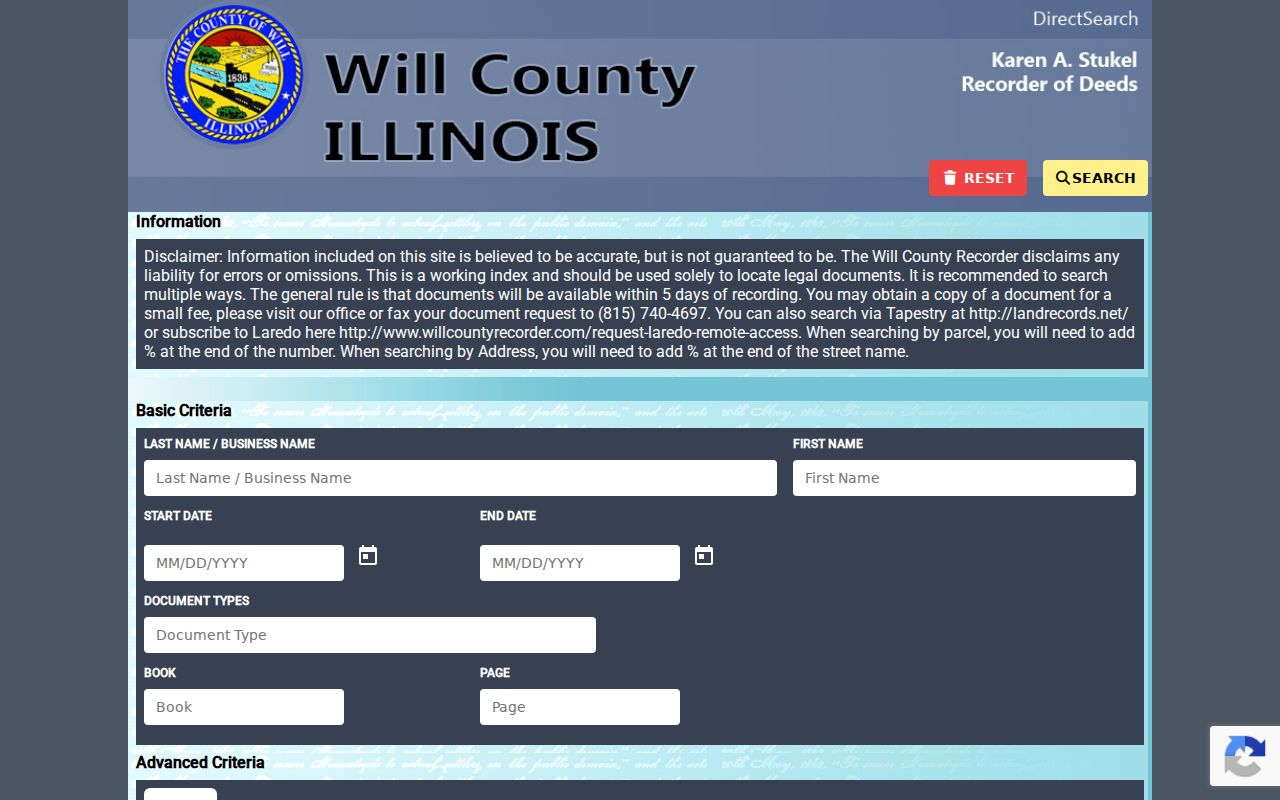
An index row is not always the full image. Preserve the document number, then use the office, Tapestry, Laredo, or copy service when the recorded image is needed.
Orland Park Records Before 1965
The Will Recorder search-options page says documents are generally online from 1965 forward. Earlier material requires office or archive work. That is a real online boundary, not the first year that property records exist. Public workstations, microfilm, plat books, and an order based on a document number extend the search.
The official options page explains how remote and in-person routes divide.
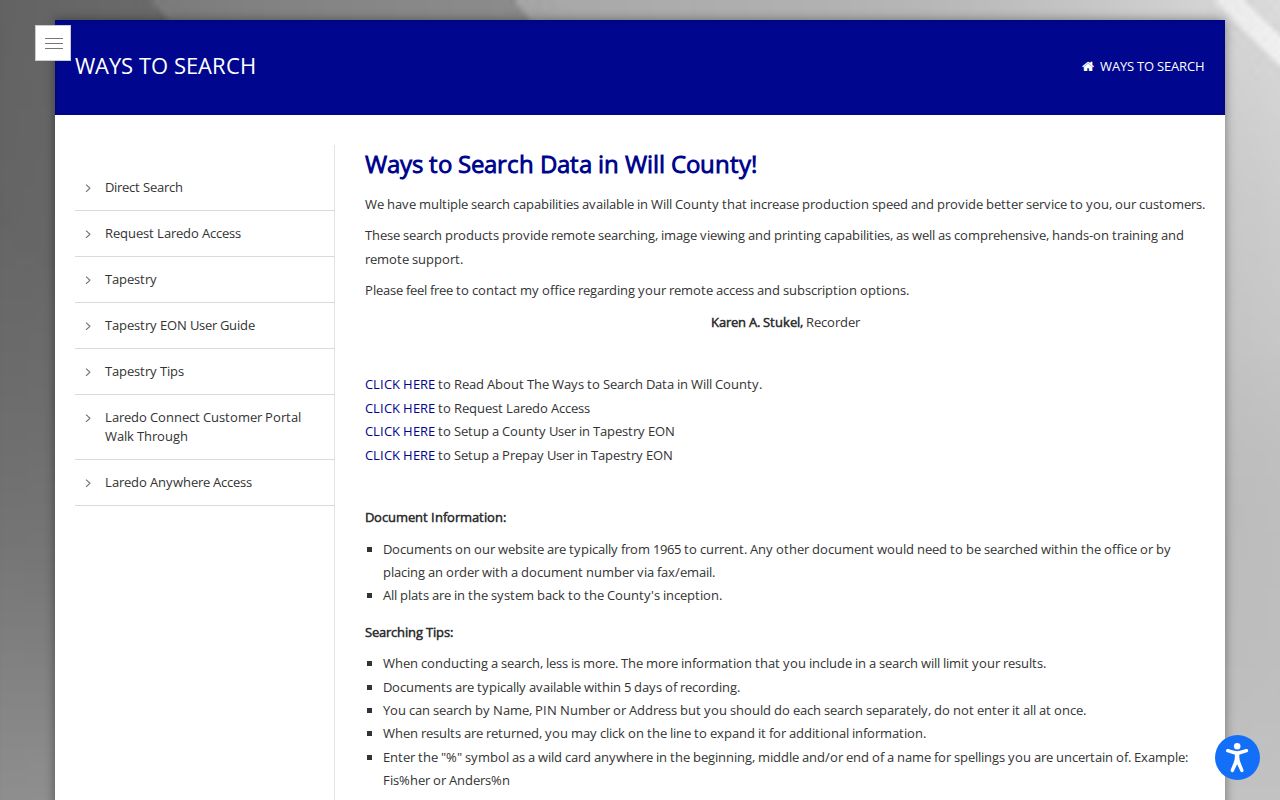
Current copy costs should be checked on the Recorder's fee page because its schedule changed on October 1, 2025. Old fee summaries may now be wrong.
Note: A 1965 web cutoff marks online access, not a gap in the underlying Will County deed books.
Cook Orland Park Resident Records
Cook County's former Recorder of Deeds no longer operates as a separate office. The recorder function moved to the County Clerk on December 7, 2020. For a Cook-side address, use Cook County Clerk Recordings, current parcel and tax tools, then ask the Clerk for a grantor/grantee or document-number search when the public interface is gated.
No verified research source gave a Cook online start year. Do not borrow Will County's 1965 date. The Cook tax portal's deed or document summary may bridge a current parcel to a document number, while older books, maps, the counter, archives, and a narrow records request extend the chain.
Orland Park Resident Survey Clues
Old Orland historic-district and rural-history surveys provide address, style, age, and contributing-status evidence. Village Development Services identifies survey work from 1984, 1991, 1995, 2005, and 2008. These dates do not prove who lived in the building, but they can verify that the same structure or parcel existed during a claimed household period.
Certificate of Appropriateness records and permit files can add plans, applicant or contractor names, inspection dates, and project scope. The inspected Village page did not publish a complete historical permit-result table. Request a permit or COA history by address through Development Services or the Village Clerk rather than assuming every old file is searchable online.
Previous Residents Beyond Old Orland
Orland Park incorporated in 1892. The original limits were roughly 151st Street on the south, 94th Avenue on the east, 143rd Street on the north, and West Avenue on the west. A modern village address outside that box may have appeared earlier under unincorporated Orland or Orland Township.
Search township tax books, plats, rural surveys, church registers, cemetery material, and county land records when the village name disappears. The 2008 residential survey's address, style, and year-built appendices are an official bridge for historic structures. County GIS geometry can also connect a current parcel to an older lot or tract.
Orland Park Resident History Model
The 1881 Senator John Humphrey House offers a local model for tracing previous residents. Its family papers, books, china, textiles, and original hardware connect the household to the property, while deeds, census pages, and burial evidence can test the same link. The collection moved from the historical society to the Village through a 2021 transfer agreement.
A water tower collapsed around 1919 and flooded the Humphrey yard and home. That event can prompt a dated newspaper or repair search. It does not show that records were lost. After renovation, the house's temporary closure ended May 30, 2026; contact Heritage Sites before seeking family or house material.
When Orland Park Records Stop
A previous-resident trail is rarely continuous. A deed marks a transfer, not the day a household moved. A directory captures one publication snapshot, while a census records one enumeration date. Permits date a project and may name an applicant or contractor without naming every occupant. Overlap the records instead of asking one source to prove the whole story.
When the Will County web index reaches its general 1965 boundary, take the last document number to the Recorder's archive and copy desk. Ask about public workstations, microfilm, plat books, and older deed books. For Cook County, record the PIN and any deed summary from the property-tax portal, then ask Cook County Clerk Recordings for an index clarification, grantor/grantee search, or copy tied to a document number. No confirmed Cook web cutoff was found, so the request should describe the parcel and date range rather than claim an online gap.
Village permit and historic-district material follows another route. Send Development Services or the Village Clerk a narrow request that states the address, PIN if known, type of file, and years sought. Illinois FOIA can reach releasable Village or county administrative records, but it does not replace the established Clerk process for court files or vital certificates. Older land, tax, probate, and local-government series may also be found through the Illinois State Archives and IRAD holdings.
The physical archive chain matters too. Orland Park Library Adult Services can confirm a directory, phone book, newspaper title, yearbook, or local-history book. Heritage Sites can check donated maps, blueprints, diaries, photographs, and family papers by appointment. The South Suburban Genealogical and Historical Society covers Orland Township and nearby south Cook and east Will communities. Ask each repository to confirm a precise volume or collection before paying for research.
Older maps deserve special care. No official search located a Sanborn fire-insurance map run specifically naming Orland Park, so do not assign the village a Sanborn year without checking the sheet title. County GIS, subdivision plats, historic surveys, rural tax books, and donated plat maps are the documented alternatives. If a PIN changed after subdivision, follow the lot, block, tract, and parcel geometry instead of joining two owners solely because the street number matches.
Orland Park Past Household Trail
Owners are only one layer. A verified reverse directory can list the subscriber or householder at a street number, while a census can identify age, birthplace, relationship, and other household members. Orland Park's exact local directory run remains unverified, so check each volume before using it. The collections and reading method are covered in the Orland Park city directory.
Use a short loop to keep the address trail tied to evidence:
- Normalize the current street number and suffix, then record any old legal description.
- Check a verified directory year in both surname and street order.
- Compare the nearest public census, through 1950, for the household and address context.
- Search library newspapers for a move, obituary, school item, or family event between dates.
- Use probate, cemetery, or a later deed to close the trail without publishing a current private address.
The Orland Park Library provides Tribune, Daily Southtown, Chicago News, Daily Herald, and other archives. Probate petitions and obituaries can connect a deceased owner to heirs, but a docket summary alone does not prove kinship. If the search stops, ask the library or Heritage Sites to confirm a volume and year, or send the correct custodian a narrow request with the PIN, address, document type, and date range.
Lawful use. Research previous residents for house history, family history, heirs, or personal curiosity. Never use an address trail to stalk, harass, or track a living person.