
Orland Park Directory Collections
No verified source gives an exact beginning-to-ending year run for an Orland Park city directory. That gap must remain visible. A 1999 Illinois library profile reported current Haines south-suburban directories and Chicago-area phone books at the Orland Park Public Library, but it did not list volume years or prove that every book indexed Orland Park. Village Heritage Sites now asks the public to donate city directories, plat books, maps, and family material, which also shows that the local shelf is still being built.
| Collection | Years | Where Held | Access |
|---|---|---|---|
| Haines south-suburban directories | Reported as current in a 1999 profile; exact run unknown | Orland Park Public Library | Ask Adult Services to verify each volume |
| Local phone books and Orland histories | Exact years not published | Orland Park Public Library local collection | Library desk and possible shelf or microform use |
| Village donated records | No fixed directory run | Orland Park Heritage Sites | Research by appointment |
| U.S. city-directory microfilm | Primarily 1861-1960 | Library of Congress | Request by place, type, and year; verify geographic coverage |
| Chicago regional volumes | Selected late nineteenth and twentieth century material | Newberry and Chicago History Museum | Digital or research-room access; not proof of Orland coverage |
Ask the library for the present call number and whether a specific Haines volume covers Orland Park, Orland Township, or only nearby suburbs. A useful request names one year and asks staff to check the title page, coverage statement, and address section. Never substitute a Chicago directory for an Orland volume merely because both are in Cook County.
Orland Park Library Research Desk
The Orland Park Public Library genealogy desk is the best first stop for local directory work. Adult Services librarians provide one-on-one help on the second floor at 708-428-5150 and info@orlandparklibrary.org. Ask for Haines directories, suburban phone books, Orland histories, Carl Sandburg High School yearbooks, newspaper files, and any local microform. A focused question gets a better answer than an open-ended person search.
The library describes Ancestry Library Edition as library-only. HeritageQuest can be used in the building or remotely with an Orland Park Library card. Both can supply census and directory records, but the search result still needs the original page. OCR often confuses initials, street numbers, and short forms.
The library's source page shows the databases and local help available before a visit.
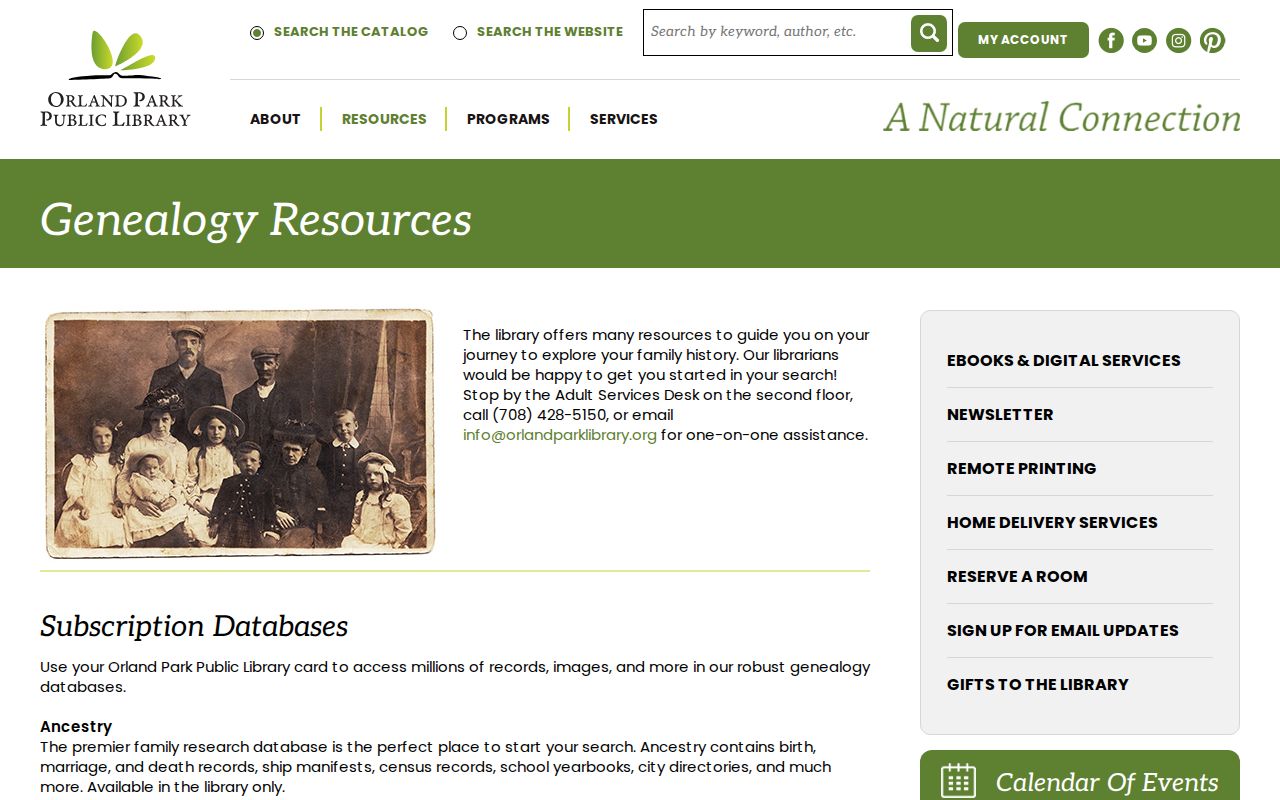
The screenshot is a starting point for staff help and database access, not a claim that a complete local year run exists.
Orland Park's Exact Year Gap
The central fact about the Orland Park city directory shelf is what researchers do not yet know: no official page located in the research identifies a complete local publisher and year span. The 1999 profile is historical evidence that Haines/suburban directories and phone books were then held, not a current catalog. Heritage Sites' donation request likewise proves interest, not coverage.
Collection check. Record the title, publisher, year, geographic scope, page number, and call number before treating a listing as an Orland Park entry.
Missing a name may mean the volume skipped Orland, the household was rural, the spelling changed, or the person moved between publication and enumeration. No authoritative source found a courthouse fire or local record-destruction event, so a gap should not be blamed on a fire.
Read an Orland Park Directory Entry
A regional city directory model shows why the front matter matters. The Chicago History Museum guide describes personal entries with a name, trade or employer context, house or boarding status, and address. Separate street, business, changes, and institutional sections may follow. These fields are a reading model only. Apply them to Orland Park after confirming that the actual volume includes the village.
| Name | Surname, given name, or initials; a spouse or widow note may follow. |
|---|---|
| Work | Occupation, trade, or firm context when the publisher collected it. |
| Address | Street number and abbreviated street name, read with that volume's key. |
| Status mark | A householder, resident, or boarder symbol only when the key defines it. |
| Change note | Removed, added, or moved entries that explain a gap between editions. |
- Criss-cross directory
- A reverse section arranged by street and house number rather than surname.
- Householder index
- A list centered on the adult or subscriber whom the publisher treated as the main entry.
- Abbreviation key
- The volume's own list of short forms. Save it because marks vary by publisher and year.
Orland Park Genealogy Databases
The library genealogy database list broadens a city directory search. Ancestry Library Edition contains directory, census, vital, ship, and yearbook material. HeritageQuest includes the federal census and more than 25,000 family and local-history books. FamilySearch access and the library's local resources can fill a gap left by a printed directory.
The available genealogy screen helps identify whether a resource requires a library visit or a local card.
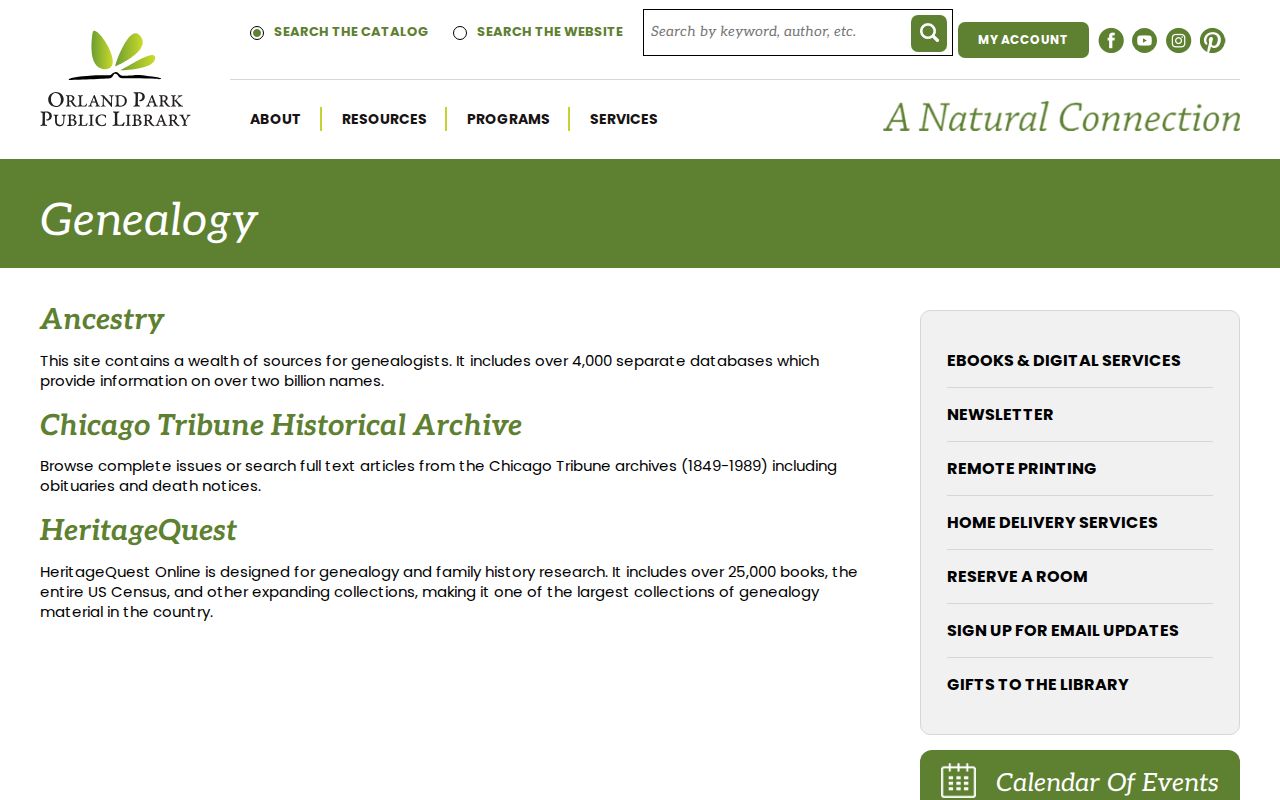
Save the database name, record collection, image number, and access date, since a name-only result can merge people from different suburbs.
Orland Park Newspaper Address Bridges
Newspapers can bridge two directory years. The Orland Park Library newspaper collection includes the Chicago Tribune historical archive for 1849-2015, Chicago Daily News for 1875-1978, Chicago Sun-Times from 1929 to today, Daily Herald from 1995 forward, and Daily Southtown and local community titles. Obituaries, school news, business notices, and civic stories may connect a name to an address.
The newspaper archive page lays out the titles and access routes.
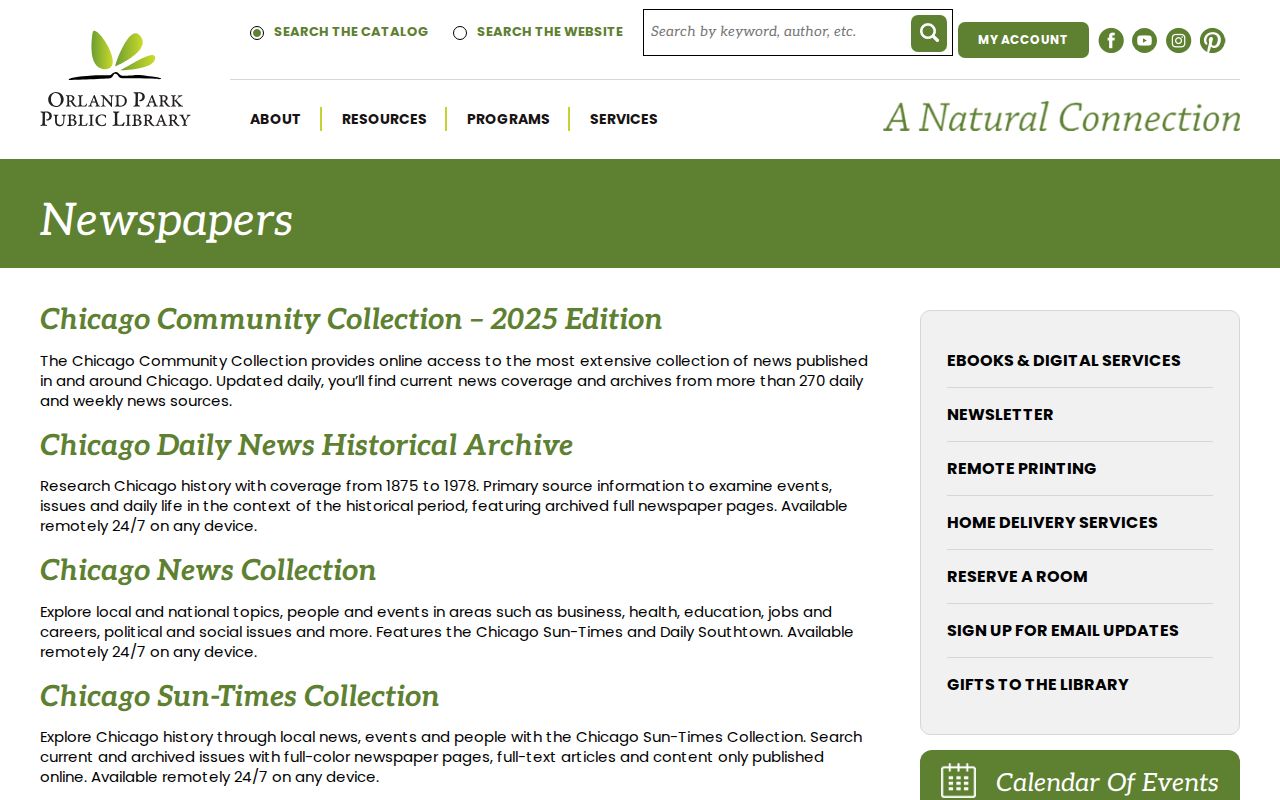
Open the original page whenever possible. Local OCR can confuse Orland Park, Orland Hills, Tinley Park, street numbers, and surnames.
Orland Park Heritage Archive
Village Heritage Sites holds letters, maps, blueprints, diaries, books, photographs, clothing, household objects, and farm material. Staff add photographs and artifacts weekly. The archive asks for city directories, plat books, family pictures, business receipts, postcards, and other Orland material, so a donated caption or receipt may place a family that never appears online.
Research is by appointment through Heritage Sites Supervisor Libby Paulson at 708-403-6268 or epaulson@orlandpark.org. The office is at 14600 S. Ravinia Avenue. Ask for a named item or date range and preserve the collection title and accession context.
Note: Confirm an appointment before travel because historical material may be stored away from the public display.
A House Behind Orland Records
The 1881 Senator John Humphrey House shows how artifacts can supplement a city directory. Family papers, books, textiles, china, and original hardware tie one household to a real place. The Orland Historical Society and Village approved a transfer of the house and collection to the Village in 2021, explaining why an older citation may now lead to a municipal custodian.
A water tower near the old Village Hall collapsed around 1919 and flooded the Humphrey yard and home. That event is a newspaper and property-timeline clue, not evidence that public record books were destroyed. The house reopened after renovation on May 30, 2026, but researchers should still contact Heritage Sites before seeking family papers.
Regional Directory Fallbacks Near Orland
The South Suburban Genealogical and Historical Society covers south Cook and east Will, including Orland Township. Its Hazel Crest library has more than 14,000 books and periodicals, volunteer research help, and FamilySearch Affiliate access. Check current hours before visiting because its published page carried a storm-closure notice during research.
The Library of Congress directory guide, Newberry digital collections, and Chicago History Museum guide help interpret regional books. Their Chicago coverage is not proof of Orland Park coverage. Search each title page for included suburbs and townships.
Orland Park Directory Time Markers
Local dates help decide which record system to search beside a city directory. Cook County was organized in 1831, Will County in 1836, and the Village dates Orland's first settlement to 1834. Passenger rail service began on August 8, 1880. Orland incorporated in 1892, so an earlier household may appear under county, township, church, land, or tax records rather than under a village heading. St. Michael Church was built in 1924, and Carl Sandburg High School opened on September 8, 1954, giving researchers two dated anchors for parish and yearbook searches.
| 1831-1836 | Cook and Will county systems begin on separate tracks. |
|---|---|
| 1880 | Rail service adds a useful newspaper and transportation-era marker. |
| 1892 | Village incorporation creates a clearer municipal record identity. |
| 1954 | Sandburg High School opens, supporting later class and yearbook research. |
| 2022 | The 1950 federal census becomes public under the 72-year rule. |
Village government also moved offices over time: municipal work left the old Village Hall in 1959, a civic center opened in 1961, and the Ravinia complex opened in 1989. A minute book, map, permit, or donated photograph may therefore follow the office that held it, not the address being studied. Ask the Village Clerk or Heritage Sites where a date-specific series was retained.
Trace Orland Park Families by Directory
Follow a household in both directions. Name order finds spelling and occupation, while address order tests who else was listed at the same place. Pair a city directory snapshot with the nearest public federal census. Public schedules for this area run through 1950; the 1960 census remains closed until 2032.
- Verify the volume year and its geographic coverage before searching a surname.
- Try initials, maiden names, punctuation, and spelling variants, then record each address exactly.
- Check the street-order section for the house number and nearby listed households.
- Compare the nearest census for age, birthplace, relationships, and household members.
- Use deeds, newspapers, probate, church records, or cemetery evidence to explain the next move or death.
A disappearance does not prove death. The person may have moved, gone unlisted, lived outside the book's boundary, or been missed. Census and obituary evidence can separate those outcomes. For a full backward chain tied to one house, use the Orland Park previous residents search.